- 305 455-4390
Critical Questions Every Business Owner Should Ask About Their Working Space in 2026
Are You a CEO or Operations Manager? Answer These Questions to Improve Productivity, Reduce Downtime, and Prepare Your Business for Growth
According to U.S. workplace technology research, employees lose productive time every day due to slow connectivity, unstable networks, poor office infrastructure, and outdated systems, issues that quietly impact efficiency, customer experience, and long-term profitability.

Most business owners think productivity problems begin with employees, software, or management processes. They invest in cloud platforms, cybersecurity tools, communication systems, AI software, and expensive office equipment hoping to improve performance and support growth.
However, one of the biggest business performance factors often stays hidden behind walls, ceilings, and server rooms:
Your physical infrastructure.
The truth is that modern businesses rely on connectivity for almost every operation. From VoIP phone calls and video meetings to cloud platforms, security systems, wireless networks, smart devices, and collaborative tools, everything depends on reliable infrastructure working correctly in the background.
When infrastructure becomes outdated, overloaded, or poorly planned, businesses start experiencing:
🡲 Slow file uploads
🡲 Video calls disconnecting
🡲 Weak Wi-Fi coverage
🡲 Frequent IT issues
🡲 Downtime interruptions
🡲 Security system instability
🡲 Employee frustration
🡲 Expensive office renovations
And in 2026, these problems are no longer considered “minor IT issues.They directly affect productivity, customer satisfaction, operational continuity, scalability, and revenue.
At Alpha Cabling, businesses across the United States are increasingly modernizing their structured cabling and network infrastructure because they understand that operational efficiency starts at the foundation.
Whether your business operates in healthcare, logistics, finance, retail, manufacturing, hospitality, education, or corporate services, your office infrastructure plays a major role in how efficiently your company performs every day.
This guide explores the three critical questions every CEO, operations manager, and business owner should ask about their workspace in 2026 and why the answers may reveal hidden operational costs affecting your business right now.
Why Office Infrastructure Matters More Than Ever in 2026
The modern workplace has changed dramatically over the last few years.
Today, businesses rely heavily on:
- Cloud-based applications
- Remote collaboration tools
- Video conferencing platforms
- Smart office technology
- AI-driven workflows
- Wireless devices
- Security and surveillance systems
- VoIP communication
- Real-time data access
Because of this shift, office infrastructure is no longer just a technical necessity. It has become a strategic business asset.
According to recent workplace technology reports, employees across the United States experience daily productivity interruptions related to slow systems, unstable connectivity, and poor technology performance. These disruptions cost businesses valuable operational time every year.
Many organizations initially blame software providers or internet companies when these issues happen. However, according to infrastructure specialists and structured cabling experts, the internal office network itself is often the real bottleneck.
Outdated cabling, overloaded network closets, poor cable organization, aging hardware, and insufficient scalability can all reduce office performance even when internet service appears normal.
This is why structured cabling and infrastructure modernization have become priorities for businesses preparing for future growth.
Question #1: How Much Time Is Your Team Losing Every Day Because of Slow Connectivity?
Most business owners underestimate how much time employees lose because of slow systems and unstable connectivity.
A few minutes waiting for files to upload may not seem significant. A frozen video call may appear like a minor inconvenience. Delayed cloud synchronization may feel manageable.
But when these interruptions happen repeatedly across an entire workforce, they create major productivity losses over time.
Imagine this scenario:
- 20 employees
- Losing only 10 minutes daily
- Due to connectivity interruptions, lag, or slow systems
That equals:
- More than 16 hours of lost productivity every week
- Over 800 hours of lost productivity every year
That is time businesses are paying for without receiving productive output.
According to workplace technology studies published in the U.S., employees increasingly depend on stable connectivity to complete daily tasks efficiently. When systems slow down, workflow interruptions affect concentration, collaboration, customer communication, and overall performance.
Businesses relying on cloud-based platforms are especially vulnerable because modern applications require stable bandwidth and low latency to function correctly.
When infrastructure cannot support modern demands, businesses often experience:
- Slow cloud performance
- Lag during Microsoft Teams or Zoom meetings
- Delayed access to shared documents
- Interrupted VoIP calls
- Weak wireless coverage
- Frequent reconnections
- File transfer delays
Many companies mistakenly assume they simply need faster internet service. In reality, the issue may be internal infrastructure limitations preventing the office from using bandwidth efficiently.
Signs Your Office Infrastructure May Be Affecting Productivity
One of the challenges with infrastructure problems is that businesses gradually normalize them over time.
Employees become used to reconnecting during calls. IT teams repeatedly solve the same issues. Managers accept delays as “part of the workflow.”
However, these are warning signs that your infrastructure may need professional evaluation.
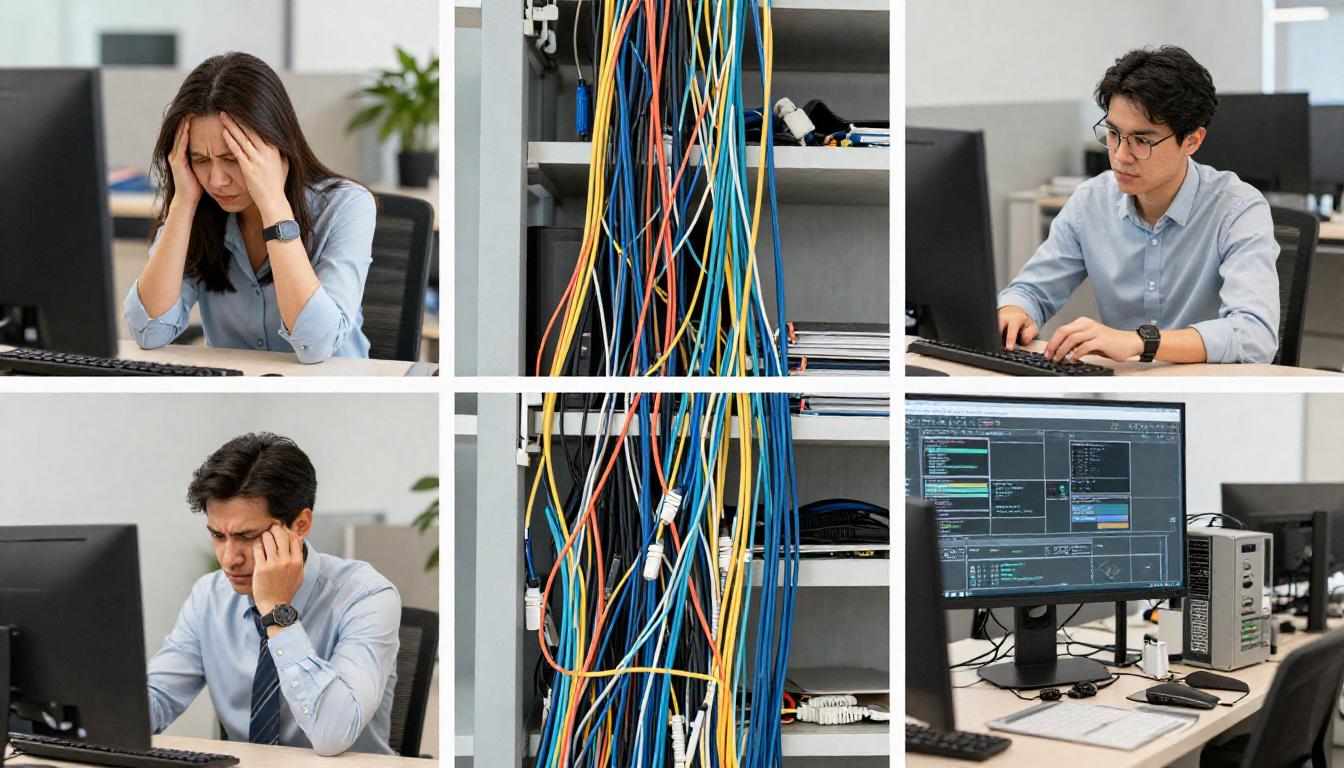
Common Productivity Warning Signs
🡲 Video Calls Frequently Freeze or Disconnect
This often indicates bandwidth bottlenecks or outdated cabling.
🡲 Employees Complain About Slow Systems Daily
Recurring complaints usually point to deeper network limitations.
🡲Cloud Platforms Take Too Long to Load
Modern cloud applications should operate smoothly with proper infrastructure.
🡲Employees Use Personal Hotspots
This often signals unreliable wireless coverage.
🡲Certain Areas of the Office Have Weak Connectivity
Poor wireless network design creates dead zones that affect workflows.
🡲IT Teams Continuously Troubleshoot Similar Problems
Repeated issues usually indicate infrastructure limitations instead of isolated technical failures.
🡲File Uploads and Downloads Are Inconsistently Slow
Large file transfers should not disrupt productivity in modern offices.
🡲Security Cameras Disconnect Intermittently
This may indicate unstable PoE cabling or overloaded systems.
When multiple warning signs appear simultaneously, the problem often extends beyond internet service itself.
The Hidden Cost of Outdated Cabling
Many businesses continue using infrastructure installed years ago before modern cloud workflows became standard.
Older cabling systems were not designed to support:
- AI-powered tools
- Smart office technology
- High-definition video conferencing
- Large-scale cloud collaboration
- IoT devices
- Advanced surveillance systems
- High-density wireless environments
As technology demands grow, outdated infrastructure creates increasing operational strain.
According to industry infrastructure research, structured cabling systems improve operational efficiency by supporting organized, scalable, and higher-performance connectivity environments.
Modern structured cabling solutions like Cat6A and fiber optics provide:
🡲 Faster transmission speeds
🡲 Lower latency
🡲 Better reliability
🡲 Reduced interference
🡲 Improved scalability
🡲 Better support for future technologies
Businesses upgrading to modern infrastructure often report improvements in:
- Workflow consistency
- Team collaboration
- Video conferencing quality
- Cloud software performance
- Operational reliability
Most importantly, employees spend less time fighting technology and more time focusing on productive work.
Question #2: When Was the Last Time Your Physical Cabling Was Inspected?
Most business owners regularly inspect HVAC systems, plumbing, fire extinguishers, and security systems.
However, many businesses never inspect the physical infrastructure supporting their network operations.
This is one of the most overlooked risks inside commercial buildings.
Over time, office cabling can experience:
- Physical wear
- Heat exposure
- Signal degradation
- Improper airflow
- Cable overcrowding
- Loose connections
- Compliance issues
- Safety hazards
These issues often remain hidden behind ceilings and walls until they create serious operational problems.
And because businesses rely so heavily on connectivity today, even small infrastructure failures can cause major disruptions.
Why Infrastructure Safety Matters in Commercial Spaces
Outdated or poorly managed cabling can affect more than performance.
It can also create:
- Fire risks
- Equipment overheating
- Operational downtime
- Compliance concerns
- Insurance liability issues
According to commercial infrastructure safety standards and structured cabling specialists, poor cable management and overloaded pathways increase operational risk inside commercial buildings.
Disorganized network environments also restrict airflow around equipment, which may contribute to overheating and hardware failure.
For business owners, this becomes both:
- A performance issue
- A business continuity issue
The challenge is that infrastructure problems usually develop gradually.
Businesses often continue operating with outdated systems until:
- A major outage occurs
- Equipment fails
- Expansion becomes difficult
- Downtime affects operations
- Compliance concerns emerge
This is why preventative infrastructure inspections are increasingly important in 2026.
Infrastructure Inspection Checklist for Business Owners
Use this checklist to identify possible infrastructure concerns inside your office.
Physical Infrastructure Checklist
➤ Cabling has been inspected within the last 24 months
➤ Network racks are clean and organized
➤ Cables are properly labeled
➤ No exposed or damaged cables exist
➤ Airflow around equipment is unobstructed
➤ Network closets are not overcrowded
➤ Cabling meets current commercial standards
➤ Cable management systems are organized
➤ Power and data cables are separated properly
Productivity & Connectivity Checklist
➤ Video calls run smoothly
➤ Employees do not report constant connectivity issues
➤ Cloud applications load efficiently
➤ Wi-Fi coverage is consistent throughout the office
➤ File transfers operate efficiently
➤ VoIP systems maintain call quality
Growth Readiness Checklist
➤ Infrastructure can support additional employees
➤ The office has extra network capacity available
➤ Expansion would not require major rewiring
➤ Current systems can support future technologies
➤ Security systems can scale easily
If several items remain unchecked, your infrastructure may already be limiting business performance.
Question #3: Can Your Current Setup Support the Next Two Years of Growth?
One of the most expensive mistakes businesses make is designing infrastructure only for present-day needs.
Many companies install enough connectivity for their current team without considering future growth.
But business operations evolve quickly.
As companies grow, they add:
- More employees
- More wireless devices
- More cloud software
- More smart technology
- More surveillance systems
- More bandwidth demands
Without scalable infrastructure, businesses eventually face:
- Expensive renovations
- Repeated rewiring
- Operational interruptions
- Temporary network fixes
- Limited office flexibility
This often leads to the frustrating cycle of opening walls repeatedly to add infrastructure that should have been planned from the beginning.
Why Future-Proof Infrastructure Saves Money
Businesses often view infrastructure upgrades as an expense rather than a strategic investment.
However, scalable structured cabling helps businesses reduce long-term operational costs by minimizing future disruptions.
Future-ready infrastructure allows businesses to:
- Expand workstations easily
- Add devices without redesigning the network
- Scale wireless systems efficiently
- Integrate smart technology
- Support AI-driven workflows
- Avoid repeated construction projects
According to infrastructure industry specialists, scalable cabling systems simplify future upgrades and reduce operational downtime associated with office expansion.
In 2026, businesses preparing for long-term growth increasingly prioritize infrastructure flexibility because technology demands continue rising rapidly.
Comparative Table: If You Are Missing This, You May Need This
If Your Business Has This Problem | You May Need This Solution |
Slow video calls and lag | Cat6A or fiber optic upgrade |
Weak Wi-Fi coverage | Professional wireless network design |
Frequent downtime | Structured cabling audit |
Overheating equipment | Organized cable management |
Poor VoIP quality | Dedicated voice/data infrastructure |
Security camera interruptions | PoE optimized cabling |
Office expansion difficulties | Scalable structured cabling |
Repeated IT troubleshooting | Infrastructure redesign |
Messy server rooms | Rack organization systems |
Constant renovations | Future-proof infrastructure planning |
Industries That Benefit Most from Structured Cabling
Modern infrastructure benefits nearly every industry because almost all businesses now depend heavily on digital operations.
Industries that particularly benefit include:
- Healthcare facilities
- Financial institutions
- Warehouses and logistics companies
- Retail businesses
- Manufacturing facilities
- Corporate offices
- Educational institutions
- Hospitality businesses
- Legal offices
- Real estate companies
Reliable infrastructure improves communication, operational continuity, and productivity across all sectors.
Tips to Identify Infrastructure Problems Before They Become Expensive
Businesses that identify infrastructure issues early can avoid costly downtime and emergency repairs.

10 Signs You Should Schedule an Infrastructure Evaluation
- Employees constantly complain about connectivity.
- Video calls freeze regularly.
- Your office has Wi-Fi dead zones.
- Cloud systems feel slower than expected.
- IT teams repeatedly solve the same network problems.
- Your office infrastructure is more than 7–10 years old.
- Equipment overheats frequently.
- Adding new devices creates network instability.
- Security systems disconnect randomly.
- Your business is growing faster than your infrastructure can support.
If your business experiences several of these warning signs, your infrastructure may already require modernization.
Final Thoughts
In 2026, office infrastructure directly affects how businesses operate, grow, and compete.
Slow connectivity, outdated cabling, unstable wireless systems, and poor scalability are no longer minor inconveniences. They impact productivity, customer experience, operational continuity, employee efficiency, and long-term profitability.
Businesses that modernize their infrastructure proactively are often better prepared for:
- Growth
- Technology expansion
- Operational efficiency
- Hybrid work environments
- AI integration
- Smart office systems
At Alpha Cabling, businesses across the United States receive structured cabling solutions designed to support reliable performance, scalability, safety, and future growth.
Because efficient businesses are built on strong foundations.
Phone: 305 455-4390
Email: [email protected]
Address: 10700 N.W Ave Suite 4 Miami, Florida 33167