- 305 455-4390
Heat Dissipation and Cable Bundling: Managing High-Density PoE++ in Cat6A Runs
In the rapidly evolving landscape of 2026 smart buildings, your network is doing much more than just moving data; it is the primary power grid for your entire office. From high-definition 8K surveillance cameras to Wi-Fi 7 access points and smart LED lighting, Power over Ethernet (PoE) is the lifeblood of modern business infrastructure.
However, there is a hidden challenge lurking within your server room walls: heat. As we push higher wattages through copper wires—specifically PoE++ (Type 4)—the physics of electrical resistance takes over. If not managed correctly through strategic cable bundling and the use of premium Cat6A cabling, this heat can lead to signal degradation, permanent cable damage, and even safety hazards.
In this guide, Alpha Cabling explores the critical relationship between heat dissipation and cable management, ensuring your high-density PoE++ deployment remains efficient, compliant, and future-proof.
The Rise of PoE++: Why Heat is the New Network Enemy
We have come a long way from the original PoE standards that delivered a mere 15.4W. Today, IEEE 802.3bt (PoE++) delivers up to 90W to 100W of power over all four pairs of a twisted-pair cable.
While this power allows us to run everything from laptops to digital signage via a single Ethernet cable, it generates significant thermal energy. “According to the IEEE 802.3bt standard,” managing the temperature rise in large cable bundles is no longer optional; it is a fundamental requirement for network reliability. When cables are packed tightly together, the heat generated by the inner cables has nowhere to escape, creating a “hot zone” that can exceed the temperature rating of the cable jacket.
The Physics of Heat Dissipation in Cable Bundles
To understand why bundling matters, we have to look at the math. When current flows through a conductor, resistance converts some of that energy into heat. In a single, isolated cable, this heat dissipates easily into the air. However, in a high-density environment where 48 or 96 cables are cinched tightly together with plastic zip ties, the cables in the center of the bundle become insulated by the outer layers.
1. Increased Insertion Loss
Heat is the enemy of speed. As the temperature of a copper cable rises, so does its electrical resistance. This leads to increased insertion loss (signal attenuation). If the temperature rises too high, your 10-Gigabit Cat6A run might struggle to maintain even 1-Gigabit speeds, leading to frustrating lag and intermittent connectivity for your business.
2. Dielectric Degradation
Modern Cat6A cables use sophisticated insulation (dielectric) to maintain pair twisting and prevent crosstalk. “According to the Telecommunications Industry Association (TIA) TIA-184-A-1 guidelines,” prolonged exposure to temperatures above 60°C (140°F) can physically degrade the cable jacket and internal insulation, potentially leading to short circuits or brittle wiring that cracks under stress.
Why Cat6A is the Gold Standard for PoE++ in 2026
If you are planning a high-density PoE++ deployment, Cat6A is not just a recommendation—it is a necessity. While Cat5e or Cat6 might technically support the data rates, they fall short in thermal management.
- Higher Gauge Wire (23 AWG): Cat6A typically uses 23 AWG copper, which is thicker than the 24 AWG found in Cat6. Thicker wire has lower resistance, meaning it generates less heat while carrying the same amount of power.
- Improved Heat Dissipation: The larger physical diameter and the internal spline (cross-filler) of Cat6A provide more surface area and internal air gaps, helping heat escape more efficiently.
- Shielding Options: Shielded Cat6A (F/UTP or S/FTP) is particularly effective for PoE++. The metallic foil acts as a heat sink, drawing thermal energy away from the core pairs and distributing it toward the ends of the cable run.
Compliance and Standards: Meeting NEC 2026 Requirements
Navigating the legalities of cabling is vital for business owners to avoid insurance liabilities and fire code violations. The National Electrical Code (NEC) has specific mandates regarding “Ampacity of Conductors.”
“According to NEC Article 725.144,” there are strict limits on how many cables can be bundled together based on the wire gauge and the temperature rating of the cable.
- LP (Limited Power) Certification: In 2026, many premium Cat6A cables carry an “LP” rating. This certification indicates that the cable has been tested to carry a specific current without exceeding its temperature rating, regardless of bundle size.
- Bundle Size Limits: For cables without an LP rating, the NEC provides a table (Table 725.144) that dictates the maximum number of cables per bundle. For high-wattage PoE++, this often limits bundles to 37, 52, or 91 cables depending on the environment.
Best Practices for Managing High-Density PoE++ Runs
At Alpha Cabling, we believe that an expert installation is the best insurance policy for your network. Here are the professional strategies we use to manage heat in 2026:
1. Use Hook-and-Loop Fasteners (Velcro)
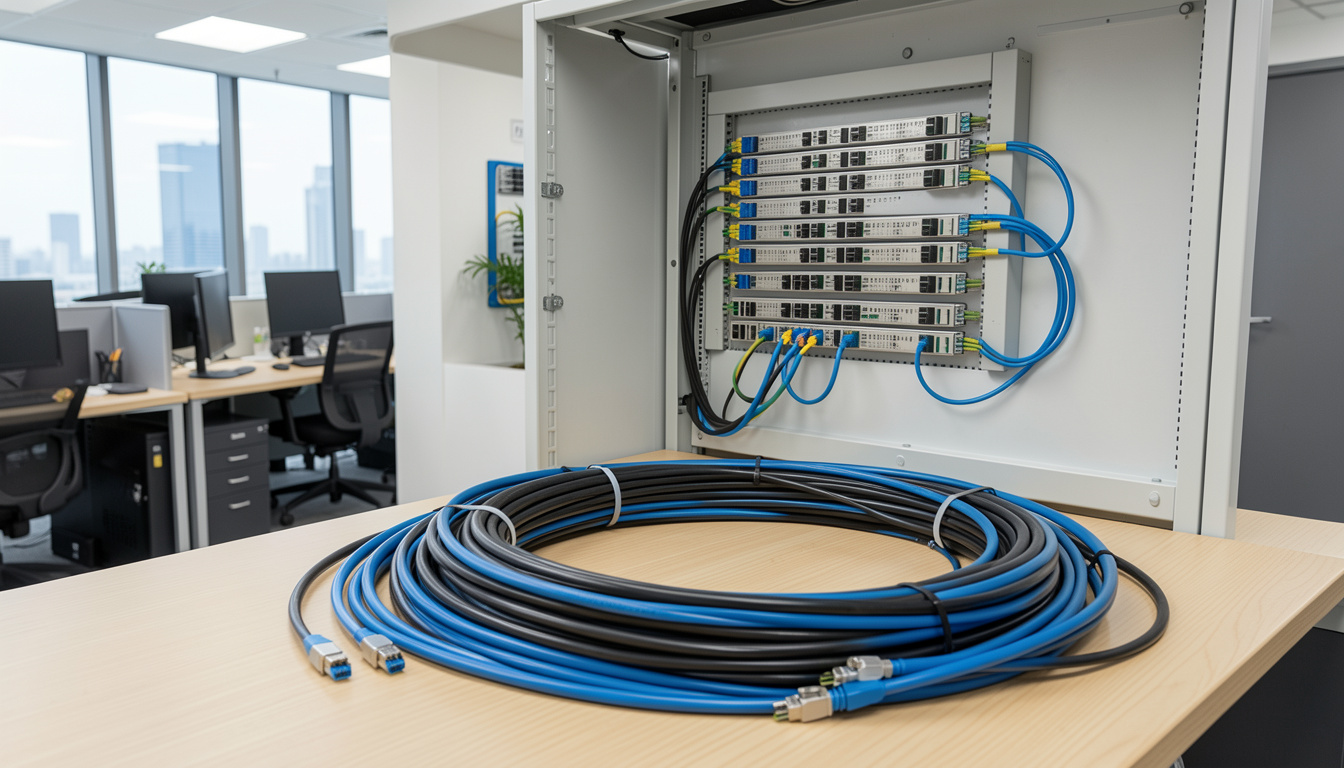
Never use plastic zip ties for high-density PoE runs. Zip ties create “pinch points” that trap heat and can deform the cable geometry. Velcro ties allow for a “loose” bundle that promotes airflow and is easy to adjust as your network grows.
2. Limit Bundle Size
Instead of one massive “trunk” of 100 cables, we recommend “combining” cables into smaller bundles of 24 or 48. This significantly increases the surface-to-volume ratio, allowing heat to dissipate from the center cables much more effectively.
3. Ensure Adequate Airflow in Pathways
Avoid overfilling cable trays and conduits. “According to BICSI international standards,” cable trays should never be filled beyond 40% to 50% of their depth to allow for proper air circulation. In high-density server rooms, active cooling or ventilated cable management hardware should be prioritized.
4. Choose High-Temperature Rated Jackets
Always opt for cables rated for at least 75°C or 90°C. This provides a “thermal buffer,” ensuring that even during peak power usage on a hot summer day, your network stays within its safe operating parameters.
Who Is This Information For?
This guide is designed for the visionaries and technical stewards who are currently building the next generation of business environments. If your role involves ensuring that your facility remains operational, safe, and efficient, this information is for you:
- IT Directors & CTOs: Who need to ensure their physical layer can support the massive power and data demands of Wi-Fi 7 and 10Gbps backhaul without thermal throttling.
- Facilities & Operations Managers: Who are responsible for building safety, NEC 2026 compliance, and the long-term integrity of the building’s infrastructure.
- Commercial Property Developers: Who want to protect their investment by installing “Future-Ready” infrastructure that won’t require a costly rip-and-replace in three years.
Why This Matters: The Industry Impact
In 2026, the gap between “standard” cabling and “expert-grade” infrastructure has widened. “According to recent 2026 low-voltage guides,” treating cabling as a commodity rather than a safety parameter is the leading cause of intermittent network failure. Here is why specific industries must prioritize heat dissipation in their Cat6A runs:
1. Healthcare & Modern Medical Campuses
Healthcare is shifting toward Smart Patient Rooms. From 8K surgical imaging to smart LED lighting systems that adjust based on circadian rhythms, every device now runs on PoE++. In a hospital setting, a “hot” cable bundle isn’t just a technical glitch; it can lead to critical system lag during a procedure.
2. Logistics, Warehousing & Industrial IoT
Modern warehouses rely on a mesh of AI-driven dashcams and thousands of IoT sensors. Because these facilities are often already exposed to higher ambient temperatures, managing cable heat is critical. “According to TIA TSB-184-A-1 standards,” failing to use loose bundling in these environments can lead to permanent dielectric degradation.
3. Education & “Smart” Campuses
Schools and universities are currently overhauling lecture halls with AV-over-IP and campus-wide Wi-Fi 7 access points. With hundreds of devices pulling 90W of power across dense ceiling runs, educational IT teams must manage heat to prevent the signal attenuation that disrupts digital learning.
4. Managed IT & Data Centers
For MSPs and data center managers, thermal management is the key to maintaining Service Level Agreements (SLAs). High-density PoE++ loads in server racks can generate enough heat to act like a space heater. Ensuring 23 AWG Cat6A is used is the only way to maintain the 10-Gigabit speeds promised to clients.
5. Hospitality & Smart Buildings
Luxury hotels use PoE to power everything from digital signage to smart room controls. Because these cables are often tucked into tight architectural spaces with zero airflow, expert heat dissipation strategies are the only thing preventing fire hazards and system brownouts.
Protect Your Infrastructure Investment
Managing heat dissipation in high-density PoE++ environments is a complex balance of physics, compliance, and strategic planning. By investing in high-quality Cat6A cabling and following modern bundling standards, you aren’t just preventing a fire hazard, you are ensuring that your business has the speed and reliability needed to thrive in a Wi-Fi 7 and AI-driven world.
Alpha Cabling specializes in the design and installation of high-performance network infrastructures that meet the rigorous demands of 2026 technology. Don’t let your network’s potential go up in smoke due to poor cable management.
Ready to Upgrade Your Network Safely?
Is your current cabling ready for the demands of high-wattage PoE++? Contact the experts at Alpha Cabling today for a professional site assessment. We’ll help you design a compliant, cool, and lightning-fast infrastructure tailored to your business needs.
Phone: 305 455-4390
Email: [email protected]
Address: 10700 N.W Ave Suite 4 Miami, Florida 33167